On planet Miro
By Glenn Adamson
Written on the occasion of “Darcy Miro: Darcy’s World” and to be included in a forthcoming catalogue published by JK Art & Design Projects
Regarding the works of Darcy Miro from a distance – across a room, say – you may feel a little like you’re approaching in a lunar lander. They are like landscapes animated by an unfamiliar genetic code, possessed of a teeming incidence. Submit to their gravitational pull, though, and you’ll soon find yourself very much at home, enjoying their many textures, colors, materials, and variously squirming, stratigraphic, and suggestive forms. Odds are you’ll want to stay a while.
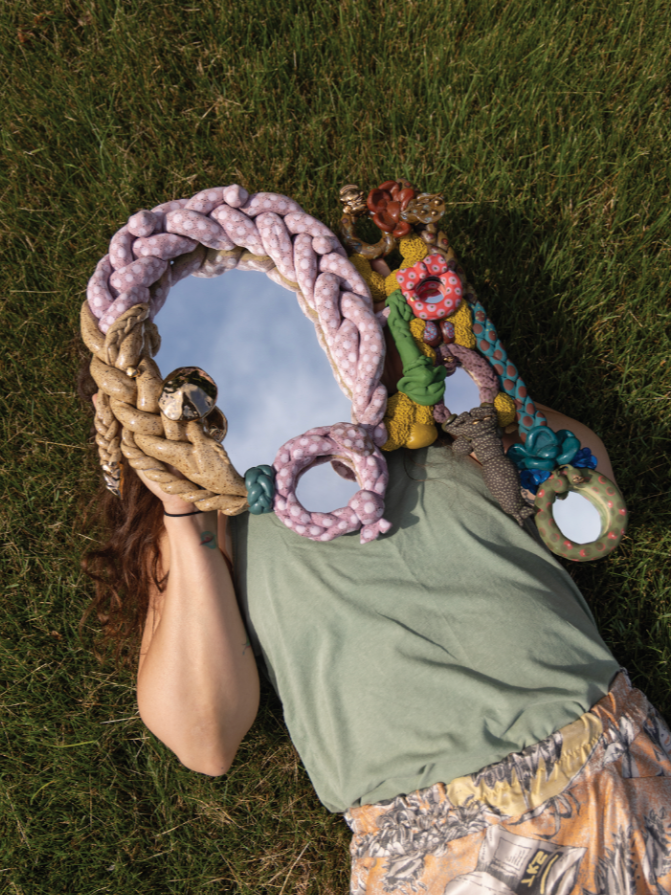
Curiously, Miro has come to this extraterrestrial aesthetic via a very earthy set of life experiences. She was born and raised in Detroit, and is the daughter of eminent critic Marsha Miro (founding director of Museum of Contemporary Art Detroit, a.k.a. MOCAD). The family home was filled with artworks, an eclectic assortment that notably included an assemblage by the sculptor Robert Sestok, composed of street finds he’d collected; Darcy recalls it as a “topographical map of his daily travel,” a description that could certainly apply to her own creations.
During her undergraduate studies at RISD, she took a year off to live in the Himalayas, helping an 85-year-old woman named Isani herd her yaks near the base of Mount Everest, learning how to weave on a backstrap loom, and drinking “butter tea” (which is just what it sounds like). More recently Miro spent a year in the jungle of Costa Rica, alternating time in a ceramic studio with animal rescue work. She began thinking of her compositions as tracts of rainforest terrain – as close to an alien world as this planet offers.
Miro, then, is an artist who goes her own way; her oeuvre is supremely unpredictable both in its detail and its overall creative arc. Her recent adoption of ceramics is just one example. Having firmly established herself in metalwork – her exquisitely rambunctious jewelry has a passionate following, and she earned early notoriety as the designer of the 63-panel bronze façade for the late and lamented American Folk Art Museum building on West 53rd Street – she up and decided to work in clay. She handles it like a child, in the best sense of that idea, thrilling to its immediacy and plasticity.
Masterful with metal as she is clay’s pliancy allows her to let her imagination run even further and faster. A monumental cast bronze pot meets its match in a pair of ceramic vessels, which evoke not so much the jungle floor as the bottom of the sea. In other clay works by Miro, the molded shapes are further enlivened by underglaze colors, just a few sophisticated shades off schoolroom Play-Doh, with some passages graced with metallic luster and polka dots (a reminder of another memorable moment in her artistic itinerary, a gallery exhibition pairing her jewelry with paintings by Yayoi Kusama). It’s a quiet riot, and supremely satisfying.
As if all this weren’t enough to be thinking about, Miro has been concurrently developing another new body of work (or perhaps it’s all one body, with multiple splaying limbs), in which she blows hot glass through constructed metal shapes. The effect is somewhat reminiscent of the “silver overlay” vessels that were popular a century ago. Miro does enjoy those antique objects for their lyricism; for all that she prizes instinctive immediacy, she also has an extensive mental catalogue of precedents: archaic neckpieces, medieval armor, the paintings of Arcimboldo, baroque architecture, Art Nouveau design.
Miro’s process, however, is diametrically opposed to the painstakingly controlled methods of silver overlay, which was achieved by painting flux on the surface of the piece, electroplating it, and then engraving the deposited metal. Her glass pieces, by contrast, are made in a rush of blood. Working alongside skilled technicians at Urban Glass in Brooklyn, she has a hot bubble blown into a handmade metal collar or sleeve, itself tricked out with enamel. There’s a brutality to this encounter of materials, one fluid and superheated, the other cold and rigid. They act on each other like alchemical reagents, producing yet more unearthly magic. In Miro’s Philla lamp, the illuminated glass blazes illusionistically, as if it were a lava lamp released from its containing flask.
With an artist so energetically prolific as this, the total effect is far more than the sum of its parts. Take one of Miro’s pieces away from the present exhibition at JK Art & Design (as a few fortunate people will), and what you’ll have is the relic of a collective ritual. Her most ambitious works, however, manifest this quality of superabundance all on their own. Have a look at Gloria, for example. (She gives her pieces women’s names, as if they were characters in a drama, which in a sense they are.) Nominally she’s a desk, with a flat resin surface to work on and a dark place underneath, lined with braids of alpaca wool, where you can put your knees. But Gloria is also unexpectedly populated with other, smaller objects – little receptacles, a light bulb on a stalk, small mirrors, and an outstretched bronze hand that you might like to hold. This is emotional support furniture: functional not only for reading and writing, but delight and reassurance.
Nala, the cast bronze coffee table that serves as the exhibition’s undoubted centerpiece, is equally emotive, despite its comparative lack of surface articulation. Most of Miro’s works are densely populated, instantly and maximally seductive. Here, the only such detail is a seam-like wire cast into the table’s underside, chasing the nether edge round in a freehand 3D scribble. Apart from that, it’s pure form – but what a form it is, sprawling sidelong in a fabulous off-kilter lurch. The coffee table has played a surprisingly substantial role in the history of avant garde furniture; Noguchi, Saarinen, Mollino, and many others recognized it as a unique expressive opportunity, a sculpture in the middle of the room just waiting to happen. With Nala, Miro brings this instinct up to date, lending the typology an unprecedented degree of animation. It’s as if the object had frozen in its tracks, just as you caught it moving out of the corner of your eye.
So far Nala is unique, but doubtless it is the first of many related forms to follow, lending it additional significance. Yet all of Miro’s creations are generative in way or another, all bestowed equally with a certain momentum. For all their impressive diversity, their capacious reach across mediums and idioms, they always drive in the same direction – towards joy. Miro is still the same person who struck out for Nepal at age 21, the one who, if she had not studio, would just sit in bed shaping ringlets of metal all day. (Have a look at the chains for her new hanging pendants and her necklaces, each link handmade – she’s still at it.) As she candidly puts it, “I have committed to making all my ideas, and letting nothing stand in my way.” She is absolutely determined to have a good time, and for her, that means making. Object by object, she is creating an elaborate but continuous self-portrait, a reflection of her own impulses. Perhaps this explains all the mirrors: we look at her exhibition, and, Argos-eyed, it looks right back. It is indeed a strange landscape, quite unlike anything else in art and design right now; yet we find ourselves in it, not once, but hundreds of times. And as alien as it may be, it’s also approachable, friendly, even intimate. Miro, you see, may seem like she’s from another world – but she comes in peace.
About the Author:
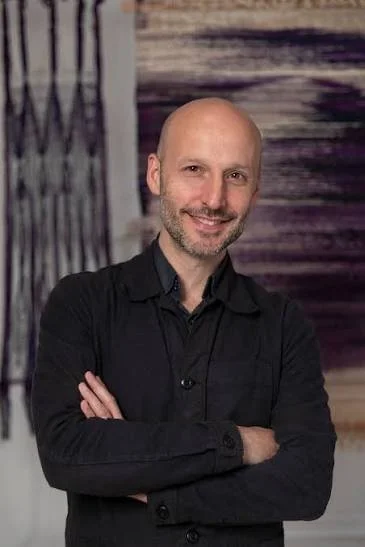
Glenn Adamson is an acclaimed writer, curator, and historian, working across the realms of craft, design, and contemporary art.. Formerly the director of the Museum of Art and Design(MAD) in Manhattan as well as head of research at the Victoria and Albert Museum, he now serves as curatorial director of Design Miami. Adamson has also had numerous articles and multiple books published and found significant success as a writer, with his newest book being A Century of Tomorrows(2024).
